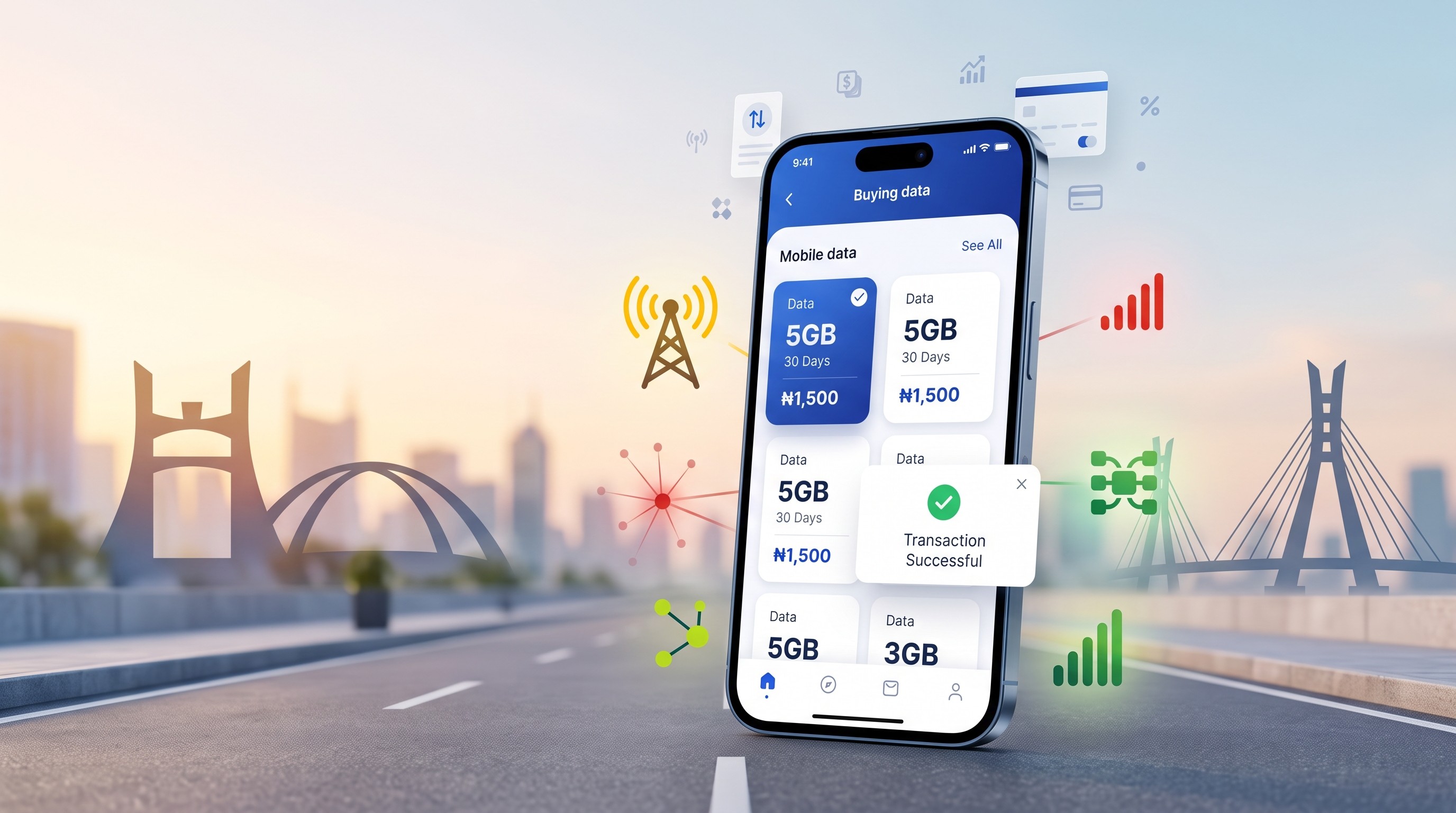
If you are building a VTU app, fintech platform, data-reselling business, wallet application, or digital-service website in Nigeria, you may eventually need a reliable way to integrate airtime and mobile data services into your platform.
Instead of building every telecom and transaction integration from scratch, developers can use a VTU API in Nigeria to connect their applications to airtime and data services through a single technical integration.
The right airtime and data API can allow a business to focus on its application, customers, user experience and business model while the API handles the underlying service transactions.
But choosing a VTU API is not simply about finding the cheapest provider.
Developers and fintech startups should consider API documentation, authentication, transaction handling, security, scalability, transaction verification, support, network coverage and the overall developer experience.
This guide explains what to look for when choosing a VTU API in Nigeria and how platforms such as the Inlomax API can fit into applications that need airtime and data infrastructure.
What Is a VTU API?
A VTU API is an application programming interface that allows software applications to interact with virtual top-up services programmatically.
Instead of manually purchasing airtime or data through a website or mobile application, another application can send an API request containing the necessary transaction information.
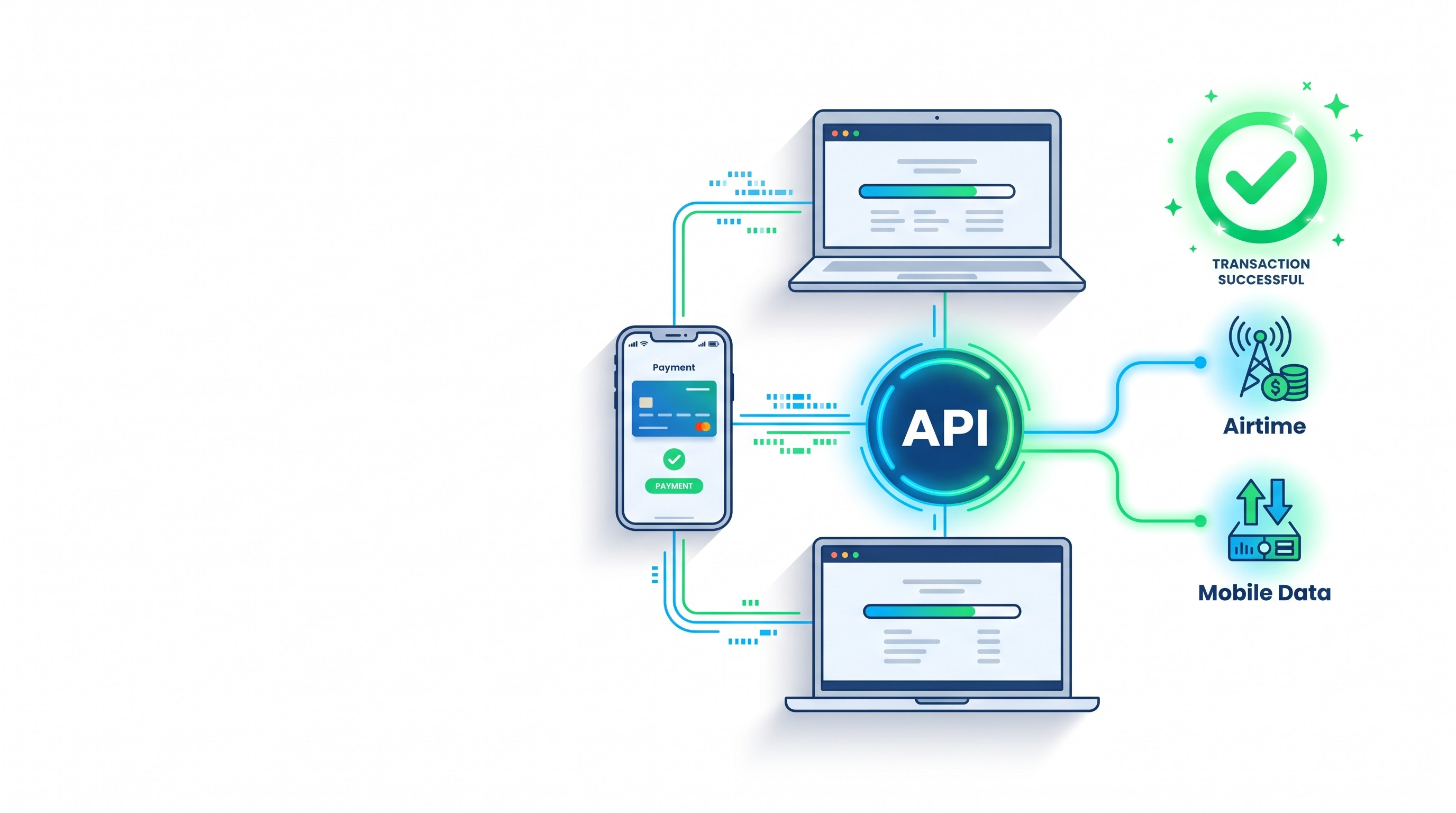
A simplified architecture looks like this:
Customer → Mobile App/Website → Business Backend → VTU API → Service Provider → Transaction Response
For example, imagine a fintech company has a mobile application with a "Buy Data" feature.
The customer selects a network and data plan. The application's backend receives the request and sends the transaction information to its VTU API provider.
The API processes the request and returns a response containing information about the transaction.
The fintech application can then update the customer's transaction status.
This allows developers to integrate digital services into their own products without requiring the end user to leave the application.
What Can You Do With a VTU API?
A VTU API can be used as infrastructure for several types of digital platforms.
Common applications include:
- VTU applications
- Airtime reselling platforms
- Data reselling platforms
- Fintech applications
- Wallet applications
- Digital-service websites
- Customer portals
- Agent platforms
- Business dashboards
- Mobile applications
Airtime recharge
An airtime API can allow an application to initiate airtime recharge transactions programmatically.
This can be useful for fintech applications, VTU platforms and businesses that want customers to purchase airtime directly from their own interface.
Mobile data
A data API can allow applications to sell mobile data without requiring customers to manually purchase data from another platform.
The application's backend can communicate with the API provider and process the transaction.
Data reselling
Businesses can build their own data-reselling interfaces around an API.
The API provides the underlying service integration while the business can focus on its own customers, pricing, branding and user experience.
Fintech applications
A fintech application can add airtime and data services alongside its existing features.
For example, a wallet application could allow users to fund their wallet and then use the balance to purchase mobile data or airtime.
What Makes a Good VTU API in Nigeria?
There are many factors to consider when choosing a VTU API provider.
Price matters, but it should not be the only consideration.
A provider offering low prices but poor transaction handling, unclear documentation or unreliable infrastructure can create significant problems for a business.
Here are the main factors developers should evaluate.
1. API Reliability
Reliability is one of the most important considerations when integrating financial or digital-service infrastructure.
A failed or delayed transaction can affect both the business and its customers.
A good API integration should provide predictable responses and mechanisms for determining whether a transaction was successful, failed or still pending.
For a fintech or VTU business, transaction reliability is directly connected to customer experience.
2. API Documentation
Good API documentation can significantly reduce integration time.
Developers should be able to understand:
- How authentication works
- Which endpoints are available
- What parameters are required
- What responses look like
- How errors are returned
- How transactions are identified
- How transaction status is checked
- How webhooks work, if supported
- How to test requests
Documentation should be written for developers rather than only describing the product from a marketing perspective.
3. Authentication and Security
API credentials should be protected carefully.
Developers should understand how authentication works and where API credentials should be stored.
For server-side integrations, sensitive API credentials should remain on the backend.
They should not be exposed in frontend JavaScript, public repositories or other locations where customers can access them.
4. Transaction Status
A good VTU system needs more than a simple "request sent" response.
Applications need to know what happened to a transaction.
Depending on the API, transactions may have statuses such as:
- Successful
- Pending
- Failed
Your application should be designed to handle each state correctly.
For example, a pending transaction should not automatically be treated as a failed transaction.
Similarly, an application should not give a customer a final success confirmation until the transaction status has been appropriately verified.
5. Transaction Verification
Transaction verification is particularly important for applications handling customer wallets or balances.
Consider a situation where a customer pays for data.
Your system sends the request to the API, but the response is delayed.
If your application assumes that the transaction failed and allows the customer to try again, you could potentially create duplicate transactions.
A robust transaction architecture should therefore include appropriate status checking and reconciliation.
6. Webhooks
Webhooks can help an API provider notify your application when something happens to a transaction.
Instead of constantly asking an API whether a transaction has changed, your backend can receive a notification when the relevant event occurs, where webhook functionality is supported.
For applications processing many transactions, event-driven transaction updates can simplify transaction management.
7. Idempotency
Idempotency is an important concept when building reliable payment and VTU systems.
Suppose a customer's request reaches your server and your server sends a transaction request to the API.
If the network connection fails before your application receives the response, your application might not know whether the transaction was processed.
Automatically sending the same request again could potentially create a duplicate transaction.
An idempotency mechanism allows systems to recognize repeated requests that represent the same intended operation.
Developers building serious VTU infrastructure should understand how their API provider handles this problem.
8. Predictable API Responses
Developers need consistent API responses to build reliable applications.
For example, a JSON response should have predictable fields that allow the application to determine:
- Whether the request was accepted
- The transaction reference
- The transaction status
- Any relevant error information
- Other information required by the application
Clear response structures make integrations easier to maintain.
9. Network Coverage
For a Nigerian VTU application, network coverage is another important consideration.
Before integrating an API, developers should verify which mobile networks and services the provider supports.
A business should not assume that every API provider offers exactly the same network coverage or products.
10. Scalability
A startup may begin with a small number of transactions.
That can change quickly.
If the application grows, the API infrastructure needs to be capable of supporting increasing transaction volumes.
When evaluating a provider, consider whether the infrastructure and API architecture are suitable for the stage your business is currently at and where you intend to take it.
11. API Limits
Developers should understand whether an API has:
- Request limits
- Rate limits
- Transaction restrictions
- Account restrictions
- Funding requirements
- Other usage conditions
Understanding these limitations before building your application can prevent problems later.
12. Technical Support
Even experienced developers can encounter integration issues.
Technical support can become important when dealing with:
- Failed transactions
- Unexpected API responses
- Pending transactions
- Authentication issues
- Webhook problems
- Transaction reconciliation
A business should understand what support is available before depending on an API for its core services.
Best VTU API in Nigeria: What Should Developers Compare?
Rather than choosing an API based only on advertising or price, developers should compare providers based on the features that affect the reliability of their application.
| Feature | Why It Matters |
|---|---|
| Airtime API | Allows applications to provide airtime services |
| Data API | Allows applications to provide mobile data services |
| Documentation | Makes integration easier |
| Authentication | Protects API access |
| Transaction status | Helps applications track transactions |
| Transaction verification | Helps prevent incorrect transaction handling |
| Webhooks | Can provide automated transaction updates |
| Security | Protects API credentials and transactions |
| Scalability | Supports growing businesses |
| Support | Helps resolve technical problems |
| API limits | Determines how the API can be used |
| Pricing | Affects business costs and margins |
There is no single criterion that determines whether an API is suitable for every business.
The right choice depends on the application's requirements, expected transaction volume, technical architecture and business model.
Inlomax API for Developers and Fintech Startups
Inlomax API is designed for businesses and developers that want to integrate digital services such as airtime and mobile data into their own applications and platforms.
Instead of requiring a business to build its entire digital-service infrastructure from scratch, an API-based approach allows developers to connect their own backend to an API provider.
This can be useful for:
- VTU businesses
- Fintech startups
- Data-reselling platforms
- Airtime-reselling platforms
- Website owners
- Mobile application developers
- Software companies
The key advantage of an API-based model is that the business can build its own customer-facing experience while connecting the backend to service infrastructure.
For example:
Customer
↓
Your Mobile App / Website
↓
Your Backend
↓
Inlomax API
↓
Airtime / Data Service
↓
Transaction Response
↓
Your Backend
↓
Customer
The customer interacts with your product rather than having to interact directly with the API provider's interface.
That means your business can maintain its own branding, user experience and application architecture.
Who Is the Inlomax API For?
VTU App Developers
If you are developing a VTU application, you can use an API integration to connect your application to airtime and data services.
This allows your development team to focus on the application itself, including:
- User accounts
- Wallets
- Transactions
- Notifications
- Customer experience
- Admin dashboards
- Reporting
- Your own business logic
The exact services and technical capabilities available should always be confirmed in the Inlomax API documentation before implementation.
Fintech Startups
A fintech application may already have users, wallets or payment functionality.
Adding airtime and data services can give customers another reason to use the platform.
For example, a fintech application could provide customers with the ability to purchase mobile data directly from their wallet.
The API handles the service transaction while the fintech company controls the customer-facing application.
Data Reselling Businesses
A data-reselling company can build its own interface around an API.
The business can focus on its customers and product experience while using API infrastructure to process data transactions.
Website Owners
A website can integrate an API so customers can purchase airtime or data directly from the website.
This can be useful for businesses that want to add digital services without redirecting customers to another platform.
Mobile App Developers
Mobile developers can build airtime and data functionality into an existing application.
However, sensitive API credentials should generally be handled by the application's secure backend rather than being embedded directly inside the mobile application.
Software Companies
Software companies can use APIs to add digital-service functionality to products they are already developing.
This can allow a company to expand its product without building every underlying service integration itself.
How Does a VTU API Integration Work?
Although each provider has its own implementation, the general process looks like this:
1. Create an API account
The business creates an account with its chosen API provider.
2. Obtain API credentials
The developer obtains the credentials required to authenticate API requests.
3. Read the API documentation
Before writing production code, the developer should understand the available endpoints, parameters and response structures.
4. Authenticate requests
The backend authenticates requests using the method supported by the API.
5. Retrieve available products
If the API provides an endpoint for available products or data plans, the application can retrieve the information required by its interface.
6. Send the transaction request
When a customer purchases airtime or data, the backend sends the appropriate request.
7. Store the transaction reference
Your system should store the relevant transaction information so that the transaction can later be tracked and reconciled.
8. Process the API response
The application processes the response returned by the API.
9. Monitor transaction status
The application determines whether the transaction is successful, pending or failed.
10. Handle each status correctly
Your application should have appropriate logic for each transaction state.
11. Implement webhooks or requery where supported
If the provider supports webhooks or transaction requery, these mechanisms can be incorporated into the application's transaction architecture.
12. Reconcile transactions
Your application should regularly ensure that its internal records match the actual transaction state.
This is particularly important for applications that maintain customer wallet balances.
Example VTU API Architecture
A production application should generally keep the API provider's credentials away from the public-facing frontend.
A simplified architecture is:
User
  ↓
Frontend
  ↓
Business Backend
  ↓
Inlomax API
  ↓
Airtime/Data Service
  ↓
Transaction Response
  ↓
Business Backend
  ↓
User
The frontend communicates with your backend.
Your backend communicates with the API.
This architecture helps prevent sensitive API credentials from being exposed to customers.
For example, putting an API secret directly inside frontend JavaScript would allow users to inspect the code and potentially obtain the credential.
API credentials should therefore be handled securely on the server side.
How to Choose a VTU API for Your Startup
Before integrating an API, ask the following questions:
Does it support the services I need?
Check whether the provider supports the networks, products and transaction types your customers require.
Is the documentation clear?
A developer should be able to understand how to authenticate requests and process responses without unnecessary uncertainty.
Can I test the integration?
Find out what testing or development environment is available before building your production integration.
How are transactions identified?
Understand the transaction reference system and how transactions can be queried later.
How are failed transactions handled?
Know what happens when a transaction fails and how your application should respond.
Can I verify transaction status?
Transaction verification is important when your application handles customer funds.
Are webhooks available?
If webhooks are supported, understand how they work and how your application should process them.
How is authentication handled?
Understand how API credentials are generated, used and secured.
Are API credentials secure?
Your application architecture should prevent sensitive credentials from being exposed.
Are there API limits?
Understand request and transaction limits before launching.
How does pricing work?
Consider both API costs and the economics of your own business.
Can the infrastructure scale?
Your provider should fit your expected growth and transaction requirements.
Is technical support available?
Understand how integration and transaction issues are handled.
Does it fit my business model?
An API that works well for one business may not necessarily be suitable for another.
Frequently Asked Questions
What is a VTU API?
A VTU API is an application programming interface that allows software applications to interact programmatically with virtual top-up services such as airtime and mobile data.
What is the best VTU API in Nigeria?
There is no universal answer because the right API depends on the developer's requirements. Businesses should compare providers based on services, documentation, reliability, transaction handling, security, scalability, pricing, support and other technical requirements.
What is an airtime API?
An airtime API allows an application to initiate airtime transactions programmatically through API requests.
What is a data API?
A data API allows software applications to interact with mobile-data services programmatically.
Can I use a VTU API to build my own app?
Yes. A VTU API can be integrated into the backend of a mobile application or website, allowing the application to offer supported digital services.
Can I integrate a VTU API into a website?
Yes. A website can communicate with a VTU API through its backend, provided the API supports the required services.
Can I integrate a VTU API with PHP?
Yes, provided the API offers HTTP/REST endpoints that can be accessed from PHP. The exact implementation depends on the provider's API documentation.
Can I integrate a VTU API with Laravel?
Yes. Laravel applications can communicate with external APIs using HTTP clients and server-side requests.
Can fintech startups use VTU APIs?
Yes. Fintech startups can use VTU APIs to add services such as airtime and mobile data to their applications, subject to the provider's supported services and requirements.
How does a VTU API transaction work?
Generally, a customer's request is received by the business application, sent from the backend to the API, processed by the service infrastructure and returned with a transaction response.
What happens when a VTU transaction fails?
The application should process the provider's failure response according to the API documentation. Depending on the architecture, the transaction may need to be retried, queried or reconciled rather than simply assumed to have failed.
What is a VTU API webhook?
A webhook is a mechanism through which an API provider can send an event notification to an application's backend when a relevant transaction event occurs, where webhook functionality is supported.
How do I secure my VTU API key?
Keep the API key on the server side, avoid exposing it in frontend JavaScript or public repositories, use secure environment/configuration management and follow the API provider's security recommendations.
Do VTU APIs have transaction limits?
Some API providers may impose request, rate or transaction limits. Developers should check the specific provider's documentation and account terms.
How do I choose a VTU API provider?
Compare providers based on the services you need, documentation, transaction handling, security, reliability, scalability, API limits, pricing, support and integration requirements.